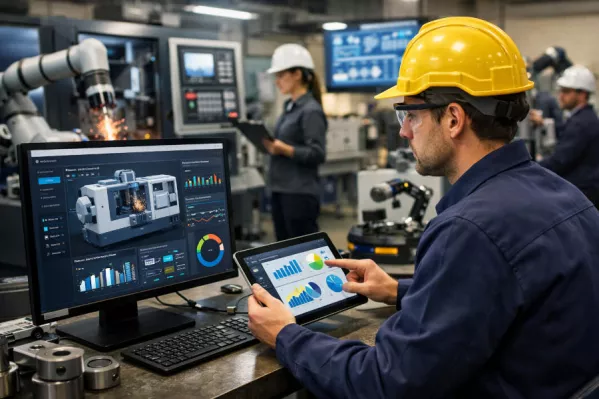
Industry 4.0 is revolutionizing modern manufacturing, and machining stands at the very center of this transformation. In smart factories, where machines communicate with one another and processes are digitally optimized, the human role not only remains relevant — it undergoes a profound redefinition. The CNC operator, once seen primarily as a manual worker, is being elevated to the role of a key specialist, engineer, and analyst who manages a technologically advanced production ecosystem.
The aim of this article is to comprehensively present this new, expanded role in the context of machining. We will examine how the operator's daily work is changing under the influence of cyber-physical systems, the Internet of Things (IoT), and artificial intelligence (AI). We will analyze the key future competencies that are becoming essential to meet the challenges and fully harness the opportunities offered by the fourth industrial revolution.
The concept of Industry 4.0 was born in 2011 at the Hannover trade fair. It marks a transition from automated to fully digitized and integrated production — a vision of smart factories in which machines, systems, processes, and people are connected in a single, self-monitoring network. The key technologies driving this change are cyber-physical systems (CPS), the Internet of Things (IoT), cloud computing, and artificial intelligence (AI).
In the context of machining, Industry 4.0 means that CNC machines are no longer isolated "production islands." They become elements of an integrated ecosystem — capable not only of executing machining programs, but also of:
The goal of these changes is to eliminate human error, reduce material and time waste, and ultimately increase production efficiency and flexibility.
In the traditional production model, the CNC operator focused on the physical operation of the machine: clamping workpieces, setting tools, initiating cycles, and inspecting finished parts. In the era of Industry 4.0, the workstation shifts from the shop floor to a data management center. Core responsibilities evolve from manual operation toward supervision, analytics, and optimization.
Data Management and Process Analytics
The modern operator must be able to navigate the flood of data generated by smart machines. Their task is not only to monitor current parameters, but above all to analyze trends, identify deviations, and draw conclusions. Based on reports from supervisory systems, they can anticipate potential issues and proactively optimize processes to minimize costs and downtime.
Supervision of Integrated Automation Systems
The operator becomes the "conductor" of an orchestra composed of machine tools, robots, conveyors, and vision systems. They must understand the operational logic of the entire production line, not just a single machine. Working with automation systems — including programmable logic controllers (PLCs) — is essential to ensure the smooth flow of materials and information. The CNC machine, supported by a PLC, becomes an active network node that responds to signals from its environment.
Using Artificial Intelligence as an Assistant
Artificial intelligence relieves the operator of many complex tasks. Rather than manually selecting cutting parameters, the operator can rely on AI recommendations that analyze material type, tool wear, and design requirements to find optimal settings. AI acts as an intelligent assistant that suggests, warns, and teaches — allowing the operator to focus on critical decisions and solving unusual problems.
The changing scope of responsibilities requires a new set of skills. The Industry 4.0 operator is a hybrid combining mechanical, programming, and analytical knowledge.
Technical and Analytical Competencies:
Soft and Interpersonal Skills:
The table below illustrates the evolution of key areas of CNC operator responsibility:
Core Tasks
Machine Interaction
Approach to Problems
Required Knowledge
Primary Tools
The transformation toward Industry 4.0 brings both challenges and enormous opportunities for CNC operators.
Challenges:
Prospects and Opportunities:
The fourth industrial revolution is permanently reshaping machining — and with it, the role of the CNC operator. From a person performing manual tasks at a machine, the operator rises to the status of a key specialist who manages processes, analyzes data, and integrates advanced systems such as AI and robotics. The work becomes more complex, but also more responsible and fulfilling.
The key to success in this new reality is continuous education and the development of digital competencies. The future belongs to operators who are not afraid of challenges and are prepared to combine traditional craft knowledge with modern technology. They will become the architects of the smart factories of the future — places where humans and machines collaborate to achieve unprecedented levels of efficiency and precision.

TOKAR CNC Technology Mateusz Maćków
