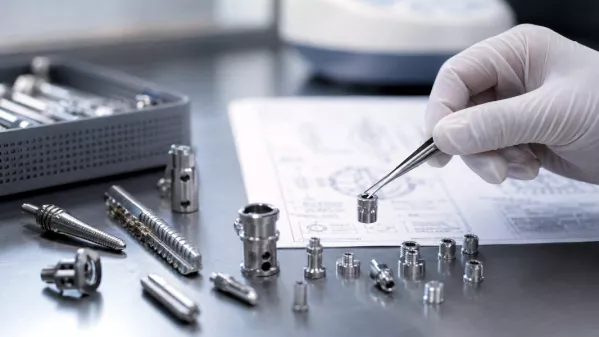
The medical industry is one of the most demanding sectors in manufacturing. The production of components used in medical equipment, diagnostic devices, and implants requires absolute precision, repeatability, and a rigorous approach to quality. At TOKAR CNC Technology, we fully understand these requirements – which is why our production processes are tailored to the highest standards in this sector.
Components used in medicine often come into direct contact with the human body or affect the functioning of devices that save health and lives. This means that:
In practice, this requires the use of advanced CNC technology and strict quality control at every stage of production.
In machining for the medical industry, choosing the right material plays a key role. The most commonly used include:
Every material must be accompanied by appropriate quality documentation (e.g. material certificates 3.1), and its machining requires expertise and precisely selected technological parameters.
Manufacturing parts for the medical industry requires maintaining very tight dimensional tolerances, often at the micrometre level. Achieving such accuracy is possible through:
At TOKAR CNC Technology, we rely on solutions that guarantee full repeatability – both in one-off and series production.
For medical components, surface quality is of paramount importance. Requirements include:
Additional processes are often necessary, such as polishing, passivation, and specialised cleaning, which ensure appropriate cleanliness and safety of the part.
In production for the medical industry, there is no room for compromise. Every stage of the process must be monitored and documented. This includes:
Quality management systems such as ISO 9001 form the foundation for organising processes and guarantee their repeatability.
One of the key requirements of the medical industry is the ability to trace the entire production process. This means that every part should have an assigned:
Such transparency not only helps meet customer requirements, but also enables a swift response in the event of any irregularities.
Even the best machinery cannot replace the knowledge and experience of the team. Manufacturing parts for the medical industry requires:
At TOKAR CNC Technology, we combine modern technology with hands-on experience, allowing us to deliver even the most demanding projects.
Metal machining for the medical industry is an area where there is no room for compromise. What matters is precision, quality, repeatability, and full process control. Meeting these requirements is only possible through a combination of advanced technology, rigorous standards, and an experienced team.
These are the very foundations on which we base our operations, delivering parts that meet the highest quality and technological requirements.

TOKAR CNC Technology Mateusz Maćków
