Before a precision-machined component reaches your hands, it goes through a process that may seem simple at first glance: drawing, machine, finished part. In reality, it is a complex sequence of decisions, calculations, and inspections, where every stage affects the final quality. At TOKAR CNC Technology, we have refined this process to combine our team's experience, advanced technology, and a consistent pursuit of perfection.
We will now take you on a journey through the six stages every component goes through — from the first line on a technical drawing to the moment it is placed in a shipping crate.
Every project begins with a conversation. Sometimes a customer comes to us with a ready-made 3D model, sometimes with a technical drawing, and sometimes with nothing more than a concept sketched on a piece of paper. Regardless of the starting point, our engineering team treats this stage with equal seriousness — because this is often where the greatest savings in time and cost can be achieved.
At this stage, we examine several key aspects:
This is where our many years of experience deliver the greatest value. A seemingly minor design change — a different fillet radius, repositioning a hole, or adjusting wall thickness — can sometimes reduce production time by more than ten percent while maintaining all key functional parameters.
Once the project has been approved, our manufacturing engineers begin programming. This is the stage where the technical drawing is translated into a language the machine can understand — G-code.
Programming involves several activities carried out in parallel:
Modern CAM systems make it possible to plan every machine movement with accuracy down to hundredths of a millimetre. 3D simulation not only displays the tool trajectory but can also predict cutting forces, tool wear rates, and even the risk of machine vibration during operation. This allows us to identify potential errors on a computer screen rather than on a finished component.
A completed and tested program is only half the battle. This is where theory meets practice, and the experience of our operators becomes decisive.
Preparing the machine for production includes:
This stage is particularly important in series production. Once a process has been correctly set up, it can be repeated hundreds or even thousands of times with identical precision — and this repeatability is one of the greatest advantages of CNC machining.
At this point, all previous preparations are translated into the actual production process. Modern CNC machines operate with impressive precision, but continuous supervision by experienced operators remains indispensable.
During machining, we continuously monitor:
For our operators, every component is a new challenge — requiring not only technical expertise but also the intuition developed through years of hands-on experience with machines. It is this combination of advanced technology and human expertise that delivers the best results.
Once the component leaves the machine, comprehensive quality inspection begins — the stage that ultimately determines whether the part is ready to be delivered to the customer.
The scope of inspection includes:
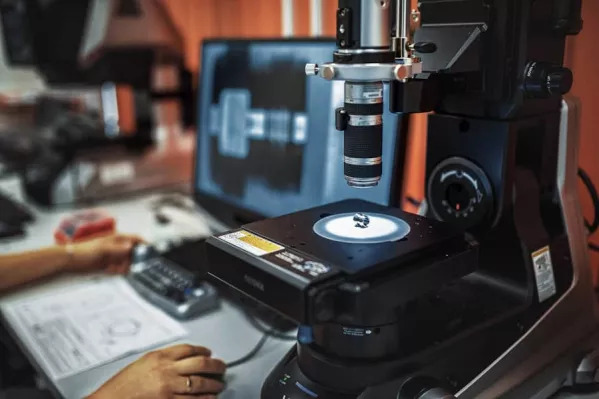
We use modern inspection methods, including coordinate measuring machines (CMMs), 3D scanners, and vision systems, allowing us to verify even the most complex geometries with exceptional precision.
The final stage is the proper preparation of components for transport. For precision CNC parts, the packaging method can be just as important as the production process itself — inadequate protection can undo the results of many hours of work. That is why we select packaging individually according to the characteristics of each component, taking into account its weight, shape, and the sensitivity of its surfaces to damage.
Every completed project is also an opportunity for us to learn. We analyse the course of the process, gather customer feedback, and introduce improvements that help us continuously raise our standards.
Our approach to continuous improvement is based on several key pillars:
When you choose a company specialising in CNC machining, you gain more than access to modern machinery. Above all, you gain the knowledge and experience of a team that guides every component through all the stages described above — with full control at every step.
In today's competitive business environment, where quality and on-time delivery can determine success, working with an experienced CNC machining contractor is an investment in your company's future. It provides confidence that your project will be completed to the highest standards — on time and within budget.
Do you have a project that requires precision CNC machining? Contact us today and discover how a professional approach to every stage of production can contribute to the success of your project.

TOKAR CNC Technology Mateusz Maćków
