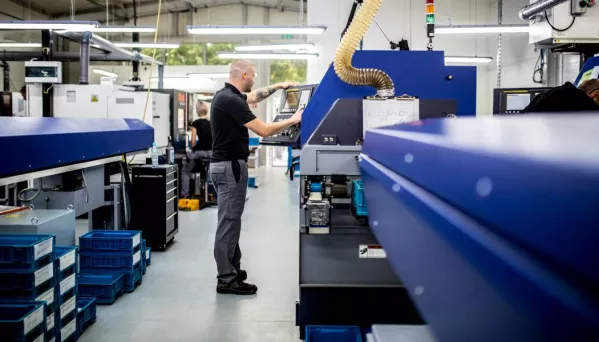
In today's industry, production speed is not the only factor that matters. Above all, accuracy, repeatability, and quality of workmanship are essential. Components used in machines, equipment, vehicles, or technical installations must meet specific dimensional requirements. Even a minor deviation can affect proper assembly, component durability, or the operation of an entire mechanism.
This is why CNC machining has become one of the most important processes in modern manufacturing. It enables the production of precision components from a wide range of materials while maintaining high quality in both one-off projects and serial production.
At TOKAR CNC Technology, we specialize in precision machining. We approach each project individually, selecting the appropriate technology according to the material, component geometry, and customer requirements.
CNC machining, or Computer Numerical Control, is a process in which computer-controlled machines perform programmed cutting operations. The cutting tool removes excess material from the workpiece, giving it the required shape, dimensions, and surface finish.
Compared with traditional machining methods, CNC technology provides significantly greater control over the process. The machine operates according to a prepared program, making it possible to achieve high accuracy and repeatability across successive components.
The key advantages of CNC machining include:
One of the fundamental machining processes is CNC turning. It involves machining a workpiece that rotates around its own axis while a cutting tool gives it the required shape.
Turning is ideally suited to the production of rotationally symmetrical parts such as:
Thanks to CNC control, both simple and more complex components can be manufactured. Various operations can be performed within a single process, including external turning, internal turning, grooving, chamfering, and threading.
One of the major advantages of CNC turning is repeatability. This is particularly important when a customer requires a larger number of components with identical parameters.
Another important process is CNC milling. In this case, material is removed by a rotating cutting tool that moves along a programmed path.
Milling can be used to produce, among other features:
It is a highly versatile method used for both one-off parts and larger production runs. CNC milling offers considerable design flexibility and makes it possible to manufacture components that would be difficult to produce using traditional methods.
Precision manufacturing requires appropriate quality control. In CNC machining, quality should not be checked only at the end of the process. It is important to analyze the documentation, prepare the process correctly, inspect the first components, and continuously monitor production.
Quality control makes it possible to verify whether a manufactured component complies with customer requirements and technical documentation. This includes checking dimensions, shape, tolerances, and surface quality.
As a result, the risk of errors can be reduced while maintaining a consistent level of quality across successive components.
CNC machining is used across many branches of industry. It is employed by companies manufacturing machinery, technical equipment, structural components, spare parts, and components used in more advanced systems.
CNC technology is particularly important wherever the following factors matter:
For this reason, CNC machining is widely used in industries including mechanical engineering, automotive, electronics, medical technology, energy, and automation.
As technology advances, the demands placed on manufacturers continue to grow. Customers expect short lead times, high quality, consistent parameters, and the ability to complete increasingly demanding projects.
CNC machining meets these needs by combining machine precision with the experience of the people responsible for preparing and managing the process. It is this combination of technology, knowledge, and practical expertise that determines the final result.
At TOKAR CNC Technology, we provide precision CNC machining services, including turning and milling. We manufacture components in accordance with technical documentation, with a strong focus on accuracy, repeatability, and quality.
Every component matters. That is why CNC machining depends not only on modern machinery but also on proper preparation, experience, and quality control at every stage of production.
Do you need precision CNC machining? Contact TOKAR CNC Technology and find out how we can help bring your project to life.

TOKAR CNC Technology Mateusz Maćków
