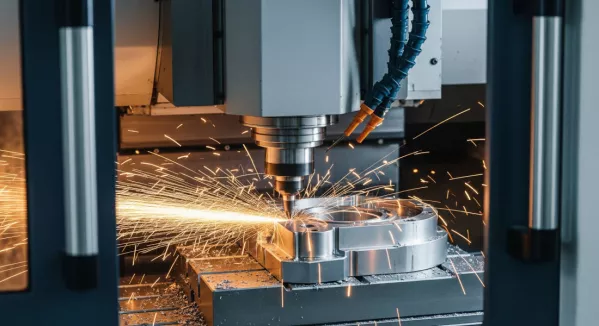
Machining is usually associated with rather technical, matter-of-fact concepts: lathes, milling machines, chips and coolant. Yet it is a field full of surprising stories, physical paradoxes and engineering achievements that rarely get discussed in everyday life. Below, we have gathered a selection of facts showing that there is far more behind the precise cutting of metal than might first appear.
In the cutting zone, temperatures can locally exceed 1,000°C – higher than the melting point of some aluminium alloys. All this energy is generated in a fraction of a second at the point where the cutting edge meets the material, and much of it is carried away by the chip itself. This is why, for an experienced operator, chip colour can be one of the best indicators of whether the process is running correctly – a golden or bluish tint on steel chips can often reveal more than many sensors.
In modern high-speed machining (HSM), cutting speeds for certain lightweight materials such as aluminium can reach several thousand metres per minute. This is still far below the speed of sound, but fast enough to generate the characteristic high-pitched whine of a machine – an acoustic phenomenon that experienced operators can recognise with their eyes closed and use to assess whether the process is running correctly.
The hardest material used in cutting tools is polycrystalline diamond (PCD). Interestingly, one of the few effective ways to machine extremely hard carbide-containing materials is to use diamond tools – in a sense, diamond can "fight" materials approaching its own level of hardness. To machine diamond itself, for example in jewellery or the semiconductor industry, another diamond or a laser is used.
Before electric motors became available, lathes were powered by hand or foot. The foot-powered treadle lathe with a flywheel remained a standard tool well into the 19th century, allowing craftsmen to machine wood and soft metals with surprising precision. The basic principle – a rotating workpiece and a cutting tool – has remained largely unchanged to this day, although foot power has been replaced by motors rated at tens of kilowatts and sophisticated numerical control systems.
The term "coolant" can be somewhat misleading. In many machining processes, its primary purpose is not to lower the temperature but to lubricate the cutting zone and remove chips. When machining certain materials, such as grey cast iron, coolant is sometimes deliberately avoided in favour of dry machining because sudden thermal shock caused by the fluid could lead to microcracks in the cutting tool. Choosing the right cooling and lubrication strategy can therefore be just as important as selecting the tool itself.
There is a common belief that CNC machine tools operate almost entirely autonomously. In practice, supervision by programmers and operators remains essential. People select cutting parameters, compensate for tool wear and respond to chatter or vibrations that no algorithm can predict with absolute certainty. Automation has significantly improved process repeatability, but it has not eliminated the need for human experience and expertise.
Many experienced machine operators can assess the condition of a cutting tool simply by listening to the machine. A characteristic high-pitched squeal may indicate unsuitable cutting conditions or a worn cutting edge, while a dull, irregular noise can signal self-excited vibrations known as chatter. In extreme cases, chatter can damage both the cutting tool and the workpiece. Modern vibration-monitoring systems essentially reproduce digitally what skilled machinists have been doing "by ear" for generations.
When machining certain lightweight metals, such as magnesium alloys, fine, dry chips can be highly flammable and may ignite if heat is not properly dissipated. This is one of the reasons why magnesium machining requires special safety procedures and dedicated equipment. Contrary to what might seem intuitive, water is often unsuitable as an extinguishing agent because magnesium can react violently with it.
In precision machining, particularly in industries such as aerospace and medical manufacturing, dimensional tolerances of just 1–2 micrometres are not uncommon. For comparison, a human hair is approximately 70 micrometres in diameter. This means that modern machining centres can operate with an accuracy many times finer than the thickness of a human hair while maintaining consistent repeatability across thousands of consecutive components.
Rake angle, clearance angle and cutting-edge radius – changing any of these parameters by even a few degrees can dramatically affect surface quality, tool life and the forces generated during machining. This is why cutting insert manufacturers develop hundreds of geometry variants tailored to specific materials and machining strategies. Choosing a "universal" tool for every application almost always means compromising on performance.
Machining is a field where precision engineering meets physics in its most tangible form – heat, sound, friction and microscopic material deformation. The deeper we explore the details of the process, the clearer it becomes that behind every smooth, polished component lies an enormous amount of technological knowledge, often developed through decades of experimentation, trial and error, and careful observation – regardless of how advanced today's CNC machines have become.

TOKAR CNC Technology Mateusz Maćków
