On a technical drawing, everything looks straightforward. The diameter has a specified value, the hole is positioned exactly where indicated, and the surface should meet a defined quality standard. So, in theory, all you need to do is program the CNC machine and start producing a hundred, a thousand, or even ten thousand identical parts.
In theory, yes. In practice, however, one of the greatest challenges in precision machining is not producing one perfect part. It is far more difficult to manufacture an entire batch in which the first, the five-hundredth, and the last component all meet exactly the same requirements.
This is what repeatability in CNC manufacturing is all about – a characteristic that is often invisible to the naked eye, yet plays an enormous role in modern industry.
One micrometer is one thousandth of a millimeter. For the human eye, this is virtually impossible to detect without appropriate measuring equipment. For a manufacturer of precision components, however, a difference measured in micrometers can determine whether a part will work correctly with the other components of a device.
This is particularly important for components used in the medical and electronics industries, as well as in precision industrial mechanisms.
That is why, in CNC manufacturing, the question is not simply: "Can we produce this part?" An equally important question is: "Can we produce it repeatedly while maintaining the required parameters?"
Modern CNC machines are often associated with almost absolute accuracy. They are computer-controlled and execute a predefined program, but this does not mean that the entire process takes place under perfectly constant conditions.
During production, factors such as machine temperature, cutting tool condition, properties of the material being machined, and conditions within the cutting zone can all change.
A tool that produced the first part may already be partially worn after hundreds of subsequent operations. After several hours of operation, the machine is in a different thermal state than it was immediately after start-up. Even material from different batches may exhibit slight variations that affect the way it is machined.
The role of CNC technology is therefore not only to precisely control tool movement, but also to create a process that is as resistant as possible to such variables.
One of the most important factors affecting repeatability is tool wear.
During turning or milling, the cutting edge is exposed to significant mechanical and thermal loads. Over time, its geometry changes. Initially, these changes are very small, but in precision manufacturing, even minor differences can eventually affect the dimensions or surface quality of the machined part.
This is why proper tool-life management is essential. Manufacturers should not wait until a tool becomes completely unusable. Its condition must be taken into account much earlier, before it begins to cause quality problems.
In series CNC production, therefore, machining speed is not the only factor that matters. The stability of the entire process is equally important.
Machining stainless steel, an area in which TOKAR CNC Technology specializes, presents a particular challenge.
Valued for its corrosion resistance, durability, and wide range of applications in demanding industries, stainless steel is not always an easy material to machine. Some grades tend to work-harden during machining, generate considerable heat, or produce difficult-to-control chips.
This makes the correct selection of tools, cutting-edge geometry, cutting speed, feed rate, and cooling extremely important.
Incorrectly selected parameters can shorten tool life and make it more difficult to maintain stable dimensions. A well-planned process, on the other hand, makes it possible to take advantage of the benefits of stainless steel while maintaining a high level of production repeatability.
A common oversimplification is to think of quality control as the final stage of production: the part comes off the machine, goes to the inspection department, and only then is it determined whether it has been manufactured correctly.
In modern manufacturing, this approach would be insufficient.
Quality control should cover the entire process – from material verification and inspection of components during production to the measurement of finished parts before shipment. This makes it possible to detect undesirable changes early and respond before the problem affects a larger number of components.
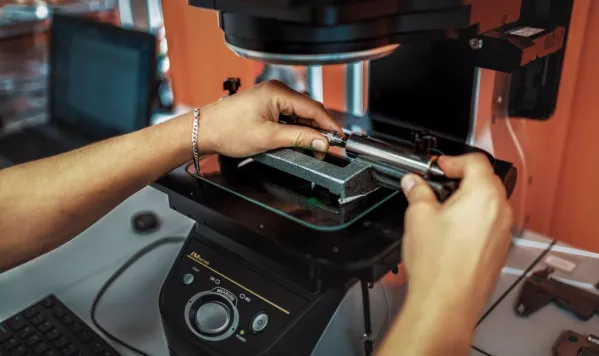
At TOKAR CNC Technology, the equipment used includes the KEYENCE IM optical measurement system, which enables hundreds of measurements to be performed on parts with an accuracy of ±2 μm. Solutions like this significantly accelerate inspection and help reduce the impact of human error.
Imagine a batch of 5,000 small bushings. Inspection of the first component shows that all its dimensions are correct. Does this mean that the remaining 4,999 parts will also comply with the technical documentation?
Not necessarily.
During production, the tool may gradually wear or the machining conditions may change slightly. An individual part may still remain within tolerance, but subsequent measurement results may move increasingly closer to the tolerance limit.
This is why effective quality control is not simply about classifying a part as "good" or "bad." Monitoring changes occurring throughout the process makes it possible to identify trends earlier and take action before non-conforming components are produced.
Precision is usually associated primarily with quality. However, it also has a very tangible economic dimension.
A stable production process means fewer defective parts, fewer reworks, lower material consumption, and a reduced risk of disrupting subsequent stages of the customer's production process.
If a component forms part of a larger device, an incorrect dimension can cause problems during assembly. In extreme cases, a single small component can bring a much more expensive production process to a halt.
Investing in repeatability is therefore not merely about striving for technical perfection. It is also a way to make production more predictable and reduce its total cost.
Automation does not eliminate the importance of employee expertise – instead, it changes the nature of their work.
A modern machine tool can repeat programmed movements with exceptional accuracy, but someone must first develop the machining process, select the tools and cutting parameters, set up the machine, monitor production, and correctly interpret measurement results.
The more demanding the component, the more important it becomes to combine the capabilities of the machine with the expertise of process engineers, operators, and quality-control specialists.
This is why, in precision CNC machining, technology and experience do not compete with each other. The best results are achieved when they complement one another.
An impressive, complex component manufactured with micrometer-level accuracy may be remarkable. From an industrial perspective, however, an even greater achievement is the ability to manufacture thousands of such parts while maintaining stable parameters.
Modern turning centers, Swiss-type automatic lathes, properly selected tools, and advanced measurement systems form a single integrated production system. Every element of that system matters.
That is why precision in CNC machining is not simply about answering the question of how accurately one part can be manufactured. The true test of technology is how accurately that same part can be produced for the thousandth time.

TOKAR CNC Technology Mateusz Maćków
