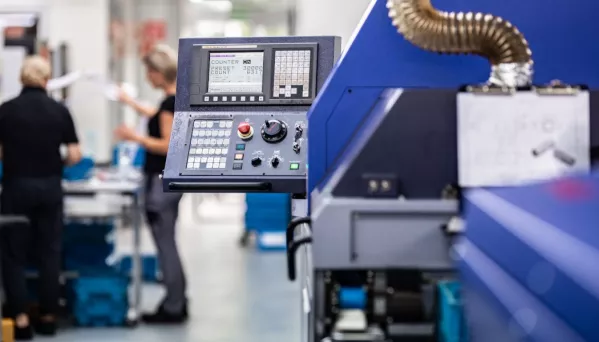
In modern industry, there is less and less room for chance. Components used in machines, equipment and advanced technical systems must meet precisely defined requirements regarding dimensions, geometry, surface quality and repeatability. In some cases, differences measured in hundredths or even thousandths of a millimetre can determine whether an entire mechanism functions correctly.
This is precisely why CNC machining has become one of the foundations of modern manufacturing. It combines the capabilities of advanced machine tools, specialist software and the expertise of experienced process engineers and operators.
At TOKAR CNC Technology, we use CNC technology to manufacture both individual, demanding components and repeatable production runs. For us, however, precision is not merely a machine parameter – it is the result of the entire process, from analysing technical documentation to the final inspection of the finished component.
CNC stands for Computer Numerical Control. A CNC machine performs programmed movements of its tools and axes according to a previously prepared program.
The program specifies, among other things:
However, this does not mean that people are no longer needed. Quite the opposite. The more advanced the technology becomes, the more important the expertise of the specialists responsible for preparing the process.
The process engineer must select the appropriate tools and parameters, anticipate how the material will behave, plan how the workpiece will be clamped and optimise the sequence of operations. The operator, meanwhile, is responsible for correctly setting up the machine and supervising the process.
The machine provides the capabilities, but only a properly designed process makes it possible to use them to their full potential.
Conventional machining was the foundation of metal component production for many years and continues to be used for certain applications. However, when components require high accuracy, complex geometries or a high level of repeatability, CNC technology offers significantly greater capabilities.
One of the greatest advantages of CNC machining is the ability to manufacture components with very high accuracy. This is particularly important for parts that will later interact with other components within a mechanism.
Even a small deviation in diameter, hole position or datum surface can affect the fit between parts, increase component wear, cause vibration or prevent correct assembly.
That is why precision machining is not simply about producing a shape that resembles the design. The finished component must remain within the specified tolerance range and meet the required geometric parameters.
In series production, manufacturing the first component correctly is not enough. The same requirements must also be met by the next dozens, hundreds or thousands of parts.
Once the process has been properly prepared, CNC machines can repeatedly perform the same sequence of operations. This makes it possible to maintain a high level of repeatability and reduce the influence of factors associated with manual machining.
Repeatability is one of the main reasons why CNC is so well suited to the production of technical components.
Modern components increasingly feature complex shapes, holes machined at different angles, precision functional surfaces, threads, pockets, grooves or features that require machining from multiple sides.
Advanced CNC machines make it possible to perform many of these operations automatically. Proper process planning can also reduce the number of times a component needs to be repositioned and clamped.
This is extremely important for accuracy. Every additional setup requires the position of the workpiece to be established again and may become another potential source of deviation.
One of the core areas of expertise at TOKAR CNC Technology is CNC turning.
In a conventional turning process, the workpiece rotates while the cutting tool removes successive layers of material. This technology makes it possible to manufacture, among other things:
Modern turning centres, however, offer far greater capabilities than simply producing cylindrical surfaces.
Thanks to driven tools and the advanced capabilities of modern machines, turning can be combined with drilling and milling. This makes it possible to produce multiple features of a component within a single manufacturing process.
The benefit is twofold – shorter lead times and fewer setups, which can affect the accuracy of the relative position of individual surfaces.
Another extremely important area of machining is CNC milling. In this process, a cutting tool equipped with cutting edges rotates, while precisely controlled machine axes gradually shape the material into the required geometry.
Milling can be used to produce, among other things:
As the number of controlled axes increases, so do the technological capabilities of the machine. Multi-axis machining allows the cutting tool to reach surfaces that would require several separate operations on a simpler machine.
However, it is not only about creating more complex shapes. Properly planned multi-axis machining can also improve accuracy and reduce production time.
One of the greatest changes CNC technology has brought to industry is the close integration of the digital world with physical manufacturing.
The process may begin with technical documentation and a 3D model. The manufacturing process for the part is then developed – tools, clamping methods, the sequence of operations and cutting parameters are selected.
CAM software makes it possible to prepare tool paths, which are then converted into instructions that can be interpreted by the machine control system.
Many decisions that ultimately influence quality, production time and manufacturing efficiency are made at this stage.
Digital process preparation is playing an increasingly important role in modern manufacturing.
Simulation can help verify the machining process before physical production begins. It allows tool paths to be analysed and helps reduce the risk of undesirable situations occurring during machine operation.
It also makes it possible to identify more efficient machining strategies.
In series production, even a small reduction in an individual cycle time can make a significant difference. If an operation is shortened by just a few seconds, the time savings become substantial when thousands of components are produced.
There is no single universal machining method suitable for every material. Steel, stainless steel, aluminium, copper and engineering plastics all behave differently during machining.
They differ in terms of:
That is why experience in machining different materials is just as important as the capabilities of the machine park itself.
Incorrectly selected parameters can lead to faster tool wear, poorer surface quality or difficulties in maintaining the required dimensions. A well-prepared process, on the other hand, makes it possible to achieve the right balance between accuracy, tool life and cycle time.
Manufacturing the component is only one part of the process. The other is confirming that it actually meets the requirements specified in the technical documentation.
At TOKAR CNC Technology, quality control is an integral part of production. Among other equipment, we use the KEYENCE IM measurement system, which enables fast and precise inspection of manufactured components.
Modern measurement systems make it possible to inspect multiple features of a component and compare the results with the specified target values.
This is particularly important in series production. Inspection is not only used to detect non-conformities – it also provides information that helps monitor process stability and enables an early response to emerging deviations.
It may seem that because a machine follows a prepared program, the human role is limited to pressing the "start" button. In practice, the opposite is true.
Behind every well-manufactured component lies a series of technological decisions:
How should the part be clamped? Which tool should be used? Which surface should be machined first? How can vibration be minimised? How can the required surface quality be achieved? How can cycle time be reduced without compromising process stability?
Answering these questions requires experience.
Modern CNC machining is therefore a combination of automation, digital technology and specialist expertise. Only by bringing these elements together can the full potential of CNC machines be utilised.
One of the major advantages of CNC technology is its flexibility.
It can be used to manufacture a single prototype or a short production run when rapid implementation of a design and the ability to introduce engineering changes are important.
At the same time, it is ideally suited to series production, where the key priorities are:
A well-prepared CNC process can evolve together with the project – from the first prototypes through to regular production of larger quantities of components.
The technological capabilities of a CNC machining company are often assessed based on the machines it operates. This is an important factor, but it is not the only one.
Even the most advanced machine tool will not guarantee the expected result without a properly prepared process.
At TOKAR CNC Technology, we combine the capabilities of an advanced machine park, including MAZAK and STAR machines, with the experience of the team responsible for preparing and carrying out production.
This enables us to approach each order as a complete manufacturing process rather than simply as an individual machining operation.
The finished component is the result of an entire chain of decisions. Technical documentation, material, machining strategy, clamping method, tools, cutting parameters, process stability and quality control all play an important role.
That is why precision CNC machining does not begin when the cutting tool first touches the material. It begins much earlier – during design analysis and process planning.
This approach makes it possible not only to manufacture accurate components, but also to reduce the risk of errors, improve repeatability and optimise costs.
At TOKAR CNC Technology, we see CNC as a tool for solving specific manufacturing challenges. We combine modern machine tools, digital production planning, quality control and specialist expertise to deliver components that meet the requirements of modern industry.
Whether the task involves manufacturing a demanding individual component, launching a short production run or ensuring repeatable production of larger quantities of parts, our starting point is always a thorough understanding of the project requirements.
Because in modern machining, precision is not just one stage of production. It is the principle that defines the entire process.

TOKAR CNC Technology Mateusz Maćków
