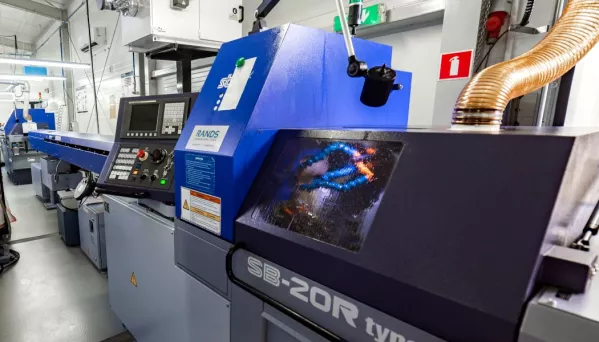
Choosing the right machining technology is one of the first decisions that needs to be made before manufacturing a part. At first glance, the choice may seem simple: a cylindrical component goes to a lathe, while a more complex one goes to a milling machine. In practice, however, the line between these technologies is not always so clear-cut.
Modern machining centers make it possible to combine multiple operations, and a properly planned process can have a significant impact on production time, accuracy, repeatability, and cost. Therefore, the question should not simply be: milling or turning? Rather, it should be: which technology will allow a specific part to be manufactured most efficiently?
Both technologies are machining processes and use computer numerical control (CNC). The main difference lies in how the cutting motion is performed.
During CNC milling, the cutting tool rotates, while the workpiece is positioned accordingly in relation to the cutter. This makes it possible to produce flat surfaces, holes, pockets, grooves, contours, and more complex three-dimensional geometries.
In CNC turning, the situation is reversed – the workpiece rotates while the cutting tool removes successive layers of material. This technology is therefore particularly well suited to manufacturing parts with rotational geometry.
This seemingly minor difference has a major impact on the capabilities of both processes.
CNC milling is one of the most versatile methods for manufacturing precision parts. Properly selected tools and programmed toolpaths allow material to be gradually removed until the required geometry is achieved.
Milling is particularly suitable when a part includes features that cannot be produced solely by machining around a single axis.
These may include:
This technology is used both for manufacturing relatively simple components and for parts requiring numerous precisely machined surfaces.
One of the strongest arguments in favor of milling is the high degree of freedom it offers when designing part geometry. If a component has multiple faces, holes, pockets, or other design features, milling is often the natural choice.
Another important advantage is the ability to perform multiple operations within a carefully planned process. Reducing the number of setups can improve production repeatability and minimize the risk of errors caused by repositioning the part.
Milling is used, among other applications, to manufacture machine parts, equipment components, housings, brackets, structural parts, and prototypes.
CNC turning demonstrates its full potential when machining parts whose geometry is centered around an axis of rotation.
The material is clamped in a chuck and rotated. The cutting tool moves along a programmed path, giving the part the required diameter, length, and profile.
This process can be used to manufacture, among other things:
For these types of components, turning combines high accuracy with excellent process efficiency.
The machine geometry and the rotational movement of the workpiece make turning particularly well suited to the rapid removal of material from rotational parts.
This is especially important in series production. When a larger number of identical components needs to be manufactured, a properly prepared CNC process ensures a high level of repeatability from one part to the next.
Another important advantage of turning is the ability to maintain precise relationships between individual diameters and surfaces machined in a single setup. For parts that interact with other components within a mechanism, this can be crucial.
This is where modern CNC machining becomes particularly interesting.
Imagine a part that is essentially cylindrical but also has side holes, a groove, a flat surface, or other features that are not symmetrical around the axis of rotation. Turning alone will not be sufficient, but performing all operations on several separate machines may not always be the most efficient solution either.
Modern turning centers equipped with additional machining capabilities make it possible to produce more complex parts within a single, carefully planned process. One example is the use of live tooling to perform additional machining operations.
The benefit is not limited to saving time. Reducing the number of times a part has to be transferred between successive operations can also help maintain the required geometric relationships and improve production repeatability.
The shape of a part is the most important indicator when choosing a machining technology, but it should not be the only criterion.
Before production begins, several other factors should also be analyzed:
Aluminum, stainless steel, structural steel, and other metal alloys behave differently during machining. The material affects, among other things, the selection of tools, cutting parameters, and machining strategies.
Not all surfaces of a part need to be manufactured to the same level of accuracy. The key is to identify the dimensions and geometric relationships that are truly critical to the proper functioning of the component.
Manufacturing a single prototype requires a different approach than producing a small batch or running repeatable series production. At higher volumes, cycle time, automation, and process stability become particularly important.
Every additional setup means another production step. Therefore, when designing the process, the goal is to make the best possible use of the machine's capabilities in order to minimize unnecessary operations and repositioning.
The least expensive individual operation does not always result in the lowest-cost finished part. Production preparation, the number of setups, machine time, tooling, quality control, and order volume all need to be taken into account.
Very often, yes.
A part that could theoretically be produced by milling may turn out to be significantly more economical if its basic geometry is first created through turning. Conversely, a component that resembles a rotational part may have so many additional surfaces and holes that milling operations play a major role in its production.
This is why expertise in CNC machining is not limited to the ability to manufacture a component according to technical documentation. Equally important is designing the right path from raw material or semi-finished stock to the finished part.
The cost of a part is largely determined before the machine is even started.
Certain design solutions may require special tools, additional setups, or more time-consuming operations. Sometimes, a minor change in geometry that does not affect the functionality of the component can significantly simplify its production.
This is why machining capabilities should be taken into account as early as the component design stage. Analyzing technical documentation before production begins can help identify solutions that are more advantageous in terms of lead time, repeatability, and cost.
Modern CNC machines are capable of producing highly accurate components, but the machine itself is only one element of the entire process.
The final result is also influenced by program preparation, tool selection, cutting parameters, workpiece fixturing, process stability, and inspection of the finished parts.
At TOKAR CNC Technology, part quality can be verified using the KEYENCE IM measurement system, enabling fast and repeatable dimensional inspection. This allows machining and quality control to form a consistent process aimed at producing parts that comply with technical documentation.
The simplest rule is: turning is the natural choice for rotational geometries, while milling is better suited to more complex shapes and components with multiple surfaces. In real-world projects, however, the answer often requires a more detailed analysis.
The best technology is not necessarily the one that simply makes it possible to manufacture the part. It is the solution that delivers the required accuracy and quality while making the most efficient use of material, tooling, machine time, and the number of operations.
At TOKAR CNC Technology, each project can be approached as an individual manufacturing challenge. Analyzing the geometry, material, tolerances, and planned production volume makes it possible to select a process that matches the actual requirements of the component.
In some cases, CNC turning will be the best solution. In others, milling will be more appropriate. For more complex components, combining different machining operations may prove to be the most effective approach.
Ultimately, the goal is not simply to choose between two technologies, but to achieve something far more important – to find the most rational and efficient way to manufacture a precision component in accordance with the project's requirements.

TOKAR CNC Technology Mateusz Maćków
