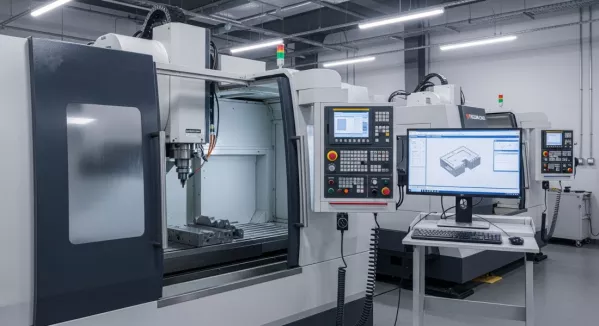
In modern industry, what matters is not only whether a particular component can be manufactured. Equally important are how quickly it can be produced, how much material will be consumed, how often errors will occur, and whether subsequent production batches will maintain identical parameters.
Imagine a manufacturing plant that needs to produce ten thousand metal components. Each must have precisely defined dimensions, the required surface quality, and geometry that allows trouble-free assembly. Even minor deviations can result in rework, production line downtime, or the rejection of an entire batch.
This is precisely where the importance of CNC (Computer Numerical Control) technology becomes particularly evident.
Computer-controlled machines combine high machining accuracy with repeatability, productivity, and opportunities for cost optimization. Moreover, their use changes the way we approach the entire production process—from design preparation and tool selection to the inspection of finished components.
Why has CNC machining become one of the foundations of modern industry? And how does it help companies manufacture faster, more economically, and with greater predictability?
Just a few decades ago, operating machine tools required operators to manually control many of the machine's movements. A lathe or milling machine operator needed not only to understand material properties and machining principles but also to independently control feed rates, cutting depths, and tool positioning.
Modern CNC technology transfers a significant portion of these tasks to a computerized control system.
The machine executes a previously prepared program that specifies, among other things:
As a result, CNC turning and CNC milling make it possible to manufacture complex components with high accuracy and repeatability.
However, this does not mean that the human role has been eliminated. Quite the opposite—the experience of engineers, programmers, and machine operators still determines whether the machine's potential is used effectively.
Automation does not replace expertise. It makes it possible to apply that expertise much more efficiently.
The history of CNC technology began long before the introduction of modern industrial computers.
The first research into numerical control of machine tools was conducted as early as the 1940s. A breakthrough came in the following decade, when systems were developed that enabled automatic control of tool movements based on recorded instructions.
Early NC machines used, among other things, punched tapes containing information about successive machine movements.
Today, such solutions may seem extremely primitive, but at the time they represented a major technological advancement.
Developments in electronics, microprocessors, and computer software led to the creation of modern CNC systems. Over time, multi-axis machine tools, automatic tool magazines, measurement systems, and solutions enabling machine integration with digital production management systems emerged.
Today, advanced machining centers can perform multiple operations in a single workpiece setup. Some systems can also automatically feed material, collect finished components, and monitor production processes.
However, the greatest transformation is not simply the increased speed of machines.
It is the ability to precisely plan, control, and repeat the manufacturing process.
The production of a precision component begins long before the cutting tool comes into contact with the material.
Every component goes through several stages, and decisions made at the beginning of the process can significantly affect its final cost.
The first step is preparing technical documentation or a three-dimensional model in a CAD (Computer-Aided Design) environment.
At this stage, the component's geometry, dimensions, tolerances, and surface quality requirements are defined.
The technological capabilities of machine tools should already be considered during the design phase.
For example, a component containing hard-to-reach surfaces, very deep holes, or exceptionally tight tolerances may require additional operations and specialized tools.
Therefore, cooperation between the designer and the CNC manufacturing engineer can sometimes reduce costs even before production begins.
The next stage involves preparing the machining program.
CAM (Computer-Aided Manufacturing) software makes it possible to develop machining strategies, select tools, and plan their movement paths.
The programmer can analyze different manufacturing approaches to find a solution that delivers the required quality with the shortest possible machining time.
Even seemingly minor details matter.
Reducing unnecessary tool movements, limiting the number of tool changes, or implementing a more efficient cutting strategy can generate measurable savings.
If a single operation is shortened by just a few seconds, the difference can translate into many hours of machine time when producing tens of thousands of components.
Once the program has been prepared, the actual machining process begins.
Depending on the type of component, CNC lathes, CNC milling machines, or multifunctional machining centers are used.
During operation, the machine performs programmed tasks while the operator supervises the process, monitors tool condition, and responds to any irregularities.
Modern machine tools make it possible to maintain stable cutting parameters and manufacture successive components according to the same program.
This is particularly important in series production, where not only the accuracy of an individual component matters but also the compliance of the entire batch with technical documentation.
The final and extremely important stage is the inspection of the finished product.
Simply using a CNC machine does not automatically guarantee that every component will meet the requirements.
Machining results are also influenced by tool wear, material properties, temperature, clamping methods, and overall process stability.
Therefore, properly planned dimensional inspection makes it possible to detect deviations and implement corrective measures.
At TOKAR CNC Technology, we use the KEYENCE IM measurement system, among other solutions, to support fast and precise dimensional inspection of manufactured components.
As a result, quality is not merely a declaration—it can be verified through actual measurements.
The most important economic benefits of CNC technology are not always immediately apparent.
Savings are generated at numerous stages of production, and their combined impact can be much greater than the machining speed alone.
In industrial manufacturing, machine operating time is one of the fundamental cost factors.
The longer it takes to manufacture a component, the greater the burden on the production workstation.
A properly programmed CNC machine helps reduce processing time by optimizing cutting parameters, tool paths, and process organization.
More advanced machines can also perform several types of operations in a single workpiece setup.
This reduces the number of auxiliary tasks and speeds up order fulfillment.
Material accounts for a significant portion of production costs, particularly when expensive metal alloys are involved.
Every incorrectly manufactured component represents not only wasted time but also the need to use additional material.
CNC technology helps reduce the risk of such losses through process repeatability and the ability to prepare machining programs accurately.
Properly selected blanks, cutting strategies, and machining parameters also contribute to efficient material utilization.
However, it is important to remember that CNC does not eliminate waste entirely. After all, machining involves removing a certain amount of material.
The objective of optimization is therefore to minimize unnecessary waste and reduce the number of components that fail to meet requirements.
Imagine a batch of one thousand metal bushings.
If some components are manufactured outside the permitted tolerances, assembly problems may arise.
The parts must then be inspected again, reworked, or manufactured from scratch.
These are additional costs that are not always considered during initial production planning.
A stable CNC process combined with appropriate quality control helps reduce the risk of such situations.
Dimensional repeatability therefore has a direct economic impact.
Changing the component being manufactured often requires preparing new tools, fixtures, and machine settings.
In traditional production environments, these activities can consume a significant portion of available time.
With CNC technology, many settings are stored in programs and manufacturing documentation.
When an order is repeated, the previously developed process can be reused, making workstation preparation easier.
Although this does not eliminate changeovers entirely, it allows them to be planned more effectively and reduces the time needed to start the next production batch.
Automation makes it possible to use the working time of skilled employees more efficiently.
Operators do not have to manually control every tool movement. Instead, they can focus on process preparation, quality control, production supervision, and solving technological problems.
In a properly organized manufacturing facility, one employee may supervise more than one workstation, provided that process conditions and safety requirements allow it.
As a result, increased productivity does not necessarily require a proportional increase in the workforce.
Every minute of unplanned downtime represents unused production capacity.
In a modern CNC environment, it is possible to monitor machine operating time, analyze the causes of stoppages, and identify operations that limit productivity.
Production data helps answer specific questions:
Is the machine waiting too long for material? Does tool replacement take longer than necessary? Is a particular operation creating a bottleneck in the entire process?
Such information makes it possible to base decisions on actual performance rather than estimates alone.
For companies ordering components, not only the unit price matters but also delivery reliability.
A delay in delivering even a small component can bring the assembly of a much larger machine to a halt.
Repeatable CNC processes make it easier to plan order completion times and estimate machine workloads.
This enables more effective production scheduling and reduces the risk of unexpected delays.
To understand the economic importance of CNC optimization, consider a simple example.
Suppose a manufacturing plant produces 20,000 identical metal components.
Initially, machining one component takes 90 seconds. After analyzing the program and changing the cutting strategy, the cycle time is reduced to 75 seconds without compromising product quality.
This is an illustrative example. The value of freed-up machine time is not equivalent to cash savings or profit; the actual result depends on machine utilization and the cost structure.
Even a small reduction in cycle time can therefore produce a significant economic benefit when applied to sufficiently large production volumes.
Importantly, savings do not necessarily require purchasing a new machine. Sometimes, improving the machining process, changing a tool, or optimizing work organization is enough.
When selecting a supplier of metal components, it is easy to focus exclusively on the unit price.
However, the actual cost of cooperation may include many additional factors.
For example, one manufacturer offers a lower price, but the supplied parts require additional inspection, sorting, or rework. Another supplier charges slightly more but provides a stable process and consistent product parameters.
In such a situation, the seemingly more expensive offer may ultimately prove more economical.
In industry, the total cost of acquiring and using a component is therefore becoming increasingly important, rather than just its manufacturing price.
This includes, among other things, the costs of quality inspection, transportation, storage, defective products, complaints, and potential assembly downtime.
Well-organized CNC machining helps reduce many of these costs.
One of the most interesting aspects of CNC machining economics is the impact of dimensional tolerances on production costs.
Technical documentation often contains very strict requirements regarding dimensions, geometry, and surface quality.
However, such high precision is not always necessary.
For example, manufacturing a component with a tolerance of ±0.1 mm may be considerably easier than achieving a tolerance of ±0.005 mm.
In the latter case, additional machining passes, stricter process control, specialized fixtures, or more precise measurements may be required.
All these factors affect manufacturing time and cost.
Therefore, one of the fundamental principles of efficient design is selecting tolerances according to the actual functional requirements of the component.
The best component from a manufacturing perspective is not necessarily the one produced with the highest possible accuracy. It is the one that meets all requirements at an optimal production cost.
The versatility of CNC technology means that it is used to manufacture both simple mechanical parts and highly advanced components.
In the automotive industry, production scale, dimensional accuracy, and the ability to maintain stable parameters over long periods are particularly important.
CNC technology is used to manufacture shafts, bushings, drivetrain components, housings, and many other mechanical parts.
In large-scale production, even a minor process improvement can generate substantial savings.
Manufacturing components for medical technology involves demanding requirements concerning geometry, materials, and workmanship.
CNC machining enables the production of precision components for medical devices, instruments, and selected implant-related applications.
In these applications, proper documentation, quality control, and compliance with requirements applicable to the specific product are especially important.
Aerospace components are often manufactured from aluminum alloys, titanium, and other materials with specialized properties.
Machining these materials requires the proper selection of tools, cutting parameters, and manufacturing strategies.
Advanced CNC machining centers enable the production of complex geometries while reducing the number of workpiece setups required.
Device miniaturization and the development of automation are increasing demand for small, precisely manufactured components.
Housings, heat sinks, mounting elements, spacers, mechanical connectors, and precision mechanism parts are just a few examples of CNC applications.
In mechanical engineering, CNC technology enables the manufacture of both individual replacement parts and larger production batches.
Flexibility is particularly important in this field.
The same machinery can handle a wide variety of projects, provided that appropriate process preparation and suitable tooling are available.
One of the greatest advantages of modern machine tools is the ability to automate successive stages of production.
Automatic bar feeders, tool magazines, part collection systems, and industrial robots help reduce the need for manual machine operation.
Under certain conditions, this also enables production without the operator being continuously present at the workstation.
However, this does not mean that every CNC machine can safely operate completely independently around the clock.
Automation capabilities depend on factors such as the material being machined, tool life, chip evacuation methods, and the effectiveness of monitoring systems.
The greatest benefits are achieved when automation is tailored to the specific manufacturing process.
In high-volume production, this can significantly increase productivity. For smaller batches, however, rapid changeovers and workstation flexibility may be more important.
The development of CNC technology is no longer limited to increasing spindle speeds or improving axis positioning accuracy.
Data analysis and the integration of machines with digital production management systems are playing increasingly important roles.
Advanced systems can analyze information related to spindle loads, vibrations, temperatures, and process performance.
Based on this data, irregularities can be detected and, in appropriately equipped systems, selected machining parameters can be adjusted.
Artificial intelligence solutions can support data analysis and manufacturing decisions, although their effectiveness depends on measurement quality and proper implementation.
An unexpected machine failure can stop production, delay orders, and generate additional maintenance costs.
Machine condition monitoring systems help identify signs of wear in specific components.
Analyzing vibrations, temperatures, and power consumption can enable earlier detection of problems and more effective maintenance planning.
The Digital Twin concept involves creating a digital representation of a machine, process, or production system.
Depending on the sophistication of the solution, it is possible to simulate machining operations, analyze system behavior, and test changes before implementing them.
This helps reduce the risk of errors and shorten the time required to prepare new processes.
Integrating CNC machines with industrial robots enables the automation of material feeding, component handling, and finished-part collection.
Such solutions are particularly attractive to manufacturing plants handling repeat orders.
However, the future does not belong exclusively to large, fully automated factories.
Flexible systems that can be quickly adapted to changing orders are also becoming increasingly important.
Although CNC technology offers numerous advantages, it is not necessarily the cheapest manufacturing method in every situation.
For very simple components produced in small quantities, conventional machining may sometimes be sufficient.
Conversely, for extremely large production volumes involving specific geometries, forming, casting, or stamping technologies may be more economical.
The choice of manufacturing method depends on several factors:
The greatest advantage of CNC is its ability to combine accuracy, flexibility, and repeatability within a single process.
This makes the technology particularly suitable for applications where component quality and production predictability are just as important as price.
At TOKAR CNC Technology, we understand that modern manufacturing requires more than simply having access to advanced machine tools.
For our customers, the most important factors are component quality, on-time delivery, and the ability to maintain consistent parameters across successive production batches.
That is why we combine manufacturing expertise with the capabilities of our modern machinery.
Our equipment includes MAZAK QT-COMPACT 200MS L CNC lathes and STAR automatic lathes, allowing us to carry out a wide range of precision metal machining operations.
We pay particular attention to proper process preparation, technology selection, and quality control.
Our work focuses on several key areas.
We analyze the manufacturing requirements of individual components and select solutions that meet the technical and economic needs of each project.
Proper process preparation helps eliminate unnecessary operations and ensures efficient use of machine operating time.
In series production, ensuring that successive components comply with technical documentation is particularly important.
That is why we focus on machining process stability, appropriate tool selection, and systematic dimensional inspection.
We use modern measurement solutions, including the KEYENCE IM system, to support dimensional verification of finished components.
This enables us to monitor product quality more effectively and identify potential deviations.
We understand that the needs of different businesses can vary significantly.
Some customers are looking for a reliable partner for repeatable series production, while others require precision components for new machines or developing designs.
That is why we approach every project individually, taking its manufacturing and organizational requirements into account.
Modern CNC machining is much more than the automatic control of tool movements.
It is an approach to manufacturing in which every stage—from design to finished-component inspection—can be analyzed and optimized.
The greatest savings do not always result from radical changes. Sometimes, shortening machining cycles, reducing the number of setups, improving material utilization, or streamlining quality control is enough.
This is why CNC technology is not only a tool for increasing manufacturing accuracy but also an important factor in building business competitiveness.
At TOKAR CNC Technology, we believe that true efficiency comes from combining modern technology, experience, and a responsible approach to every component.
Are you looking for a partner specializing in precision CNC turning and metal machining? Contact TOKAR CNC Technology. We will help you select manufacturing solutions tailored to your project's requirements, taking quality, repeatability, and production costs into account.

TOKAR CNC Technology Mateusz Maćków
