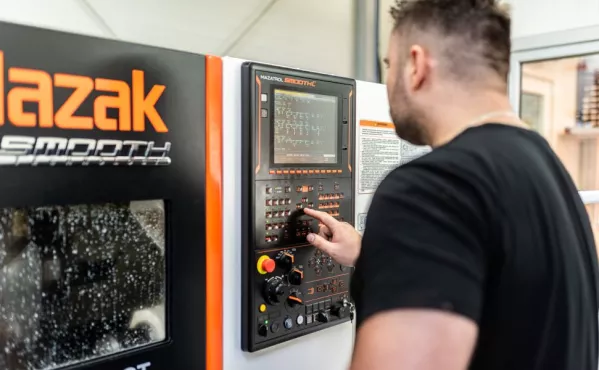
Just a few decades ago, manufacturing complex metal components required extensive operator experience, numerous manual operations, and time-consuming machine setup. Producing a part with intricate geometry often meant using several different machine tools, repeatedly clamping the workpiece, and performing numerous inspection measurements. Today, many of these operations can be completed on a single modern CNC lathe, achieving levels of precision that were once extremely difficult to obtain in serial production.
Modern CNC lathes are advanced machining centers capable of much more than simply shaping a rotating piece of metal. They combine turning, drilling, threading, and, in suitable configurations, milling operations. Thanks to sophisticated control systems, automation, and precision measurement technologies, they enable the production of components with complex geometries while maintaining high repeatability and productivity.
At TOKAR CNC Technology, we take advantage of modern machine tools to carry out demanding projects for customers across various industries. Let's take a closer look at the technologies that have made modern CNC turning one of the most important processes in precision metal machining.
A traditional lathe operates according to a relatively simple principle. The workpiece rotates while a cutting tool removes successive layers of material, giving it the desired shape. For many decades, operators manually controlled tool movements, adjusted machining parameters, and checked the resulting dimensions.
The introduction of CNC (Computer Numerical Control) technology completely transformed this process. Instead of manually guiding the cutting tool, the operator prepares a program that defines its position, movement path, spindle speed, and other machining parameters. The control system then executes the programmed operations with high accuracy and repeatability.
However, the real revolution came with the development of multitasking machine tools. A modern CNC lathe is no longer limited to machining cylindrical surfaces, tapers, or threads. Thanks to additional axes, driven tools, and advanced spindle systems, it can perform operations that previously required milling machines, drilling machines, or other equipment.
As a result, modern turning centers increasingly function as complete production stations capable of performing a substantial portion of the machining required for complex components without transferring them between different machines.
One of the most impressive capabilities of modern CNC lathes is their ability to combine turning and milling operations. In traditional manufacturing processes, producing a shaft with cross holes, grooves, or flat surfaces often required at least two different machine tools.
First, the component was turned and then transferred to a milling machine, where the remaining operations were performed. Each additional setup required repositioning the workpiece, increasing production time and the risk of geometric inaccuracies.
Modern turning centers equipped with driven tools and suitable numerically controlled axes significantly reduce these problems.
A single machine can perform operations such as:
This approach helps shorten order lead times, reduce material handling operations, and improve the positional accuracy of machined surfaces relative to one another.
For customers, this means not only more efficient production but also the possibility of manufacturing complex components more economically.
One of the technologies that has significantly expanded the capabilities of CNC lathes is the C-axis. It enables precise control of the spindle's angular position, allowing the workpiece to be accurately positioned relative to the cutting tool.
In a conventional lathe, the spindle is primarily responsible for rotating the material during machining. In a machine equipped with a C-axis, it can also function as a precision positioning system.
This makes it possible to perform operations requiring a specific angular orientation, such as drilling holes distributed around the circumference of a shaft, milling flat surfaces, or producing grooves at precisely defined positions.
The machinery at TOKAR CNC Technology includes the MAZAK QT-COMPACT 200MS L turning center, equipped with a C-axis offering a positioning resolution of 0.001°.
Such precise angular positioning opens up a wide range of technological possibilities. However, it is important to remember that axis positioning resolution is not equivalent to the guaranteed geometric accuracy of the finished component, which also depends on numerous other factors.
In practice, the C-axis makes it possible to carry out more complex projects while reducing the need for additional machining stations.
Another feature that significantly increases the functionality of modern CNC lathes is the use of a sub-spindle, also known as a pick-off spindle.
In traditional turning processes, machining both sides of a component often requires stopping the machine, removing the workpiece from the chuck, turning it around, and clamping it again. These operations take time and can affect the positional accuracy between the machined surfaces.
Lathes equipped with two spindles allow a substantial part of this process to be automated.
After machining the first side, the sub-spindle takes over the workpiece, allowing further operations to be performed on the opposite end. With a properly designed manufacturing process, the entire cycle can be completed without the operator manually transferring the component.
This solution offers several important benefits. Above all, it reduces handling time, minimizes manual operations, and improves process repeatability. It also facilitates the automation of serial production, particularly for components requiring precise machining on both sides.
The MAZAK QT-COMPACT 200MS L used at TOKAR CNC Technology is an example of a machine equipped with a sub-spindle. This enables more advanced machining processes and increases production flexibility.
Not all industrial components are large. Many industries require small parts with complex geometries, whose production demands exceptional machining stability.
These may include small pins, bushings, shafts, fasteners, components of precision mechanisms, or parts used in technical equipment.
For such applications, Swiss-type automatic lathes, also known as Swiss-type turning machines, are particularly effective.
Their operating principle differs from that of conventional lathes. Bar stock moves axially through a guide bushing, while the cutting tools operate close to the point where the material is supported.
This design effectively reduces material deflection during machining. It is especially important for long, slender components, which may be particularly susceptible to vibration and deformation on conventional lathes.
At TOKAR CNC Technology, we use STAR Swiss-type automatic lathes, which are an important part of our technological capabilities.
Machines of this type are particularly well suited to the serial production of small components, combining high productivity with the ability to perform complex machining operations.
What makes modern Swiss-type lathes especially interesting is their ability to carry out numerous operations within a single machining cycle using different tools and numerically controlled axes. Depending on the machine configuration, selected operations can also be performed simultaneously, further reducing production time.
One of the most fascinating aspects of modern CNC machining is the dimensional accuracy that can be achieved.
In conventional metalworking, deviations of one-tenth of a millimeter may seem insignificant. However, for precision mechanical components, permissible tolerances can be many times smaller.
It is worth remembering that one micrometer (µm) equals one-thousandth of a millimeter. This means that a deviation of 5 µm is equivalent to just 0.005 mm.
Achieving such accuracy requires the right combination of machine capabilities, machining system rigidity, cutting tool quality, properly selected machining parameters, and stable operating conditions.
Temperature also plays an important role. Metal expands when heated, so even small temperature changes in the workpiece can affect particularly demanding machining operations.
Modern machine tools use various solutions to minimize the influence of thermal factors, including appropriate cooling systems, operating condition monitoring, and compensation for selected deviations.
However, this does not mean that every CNC lathe can automatically manufacture any component with tolerances of just a few micrometers. Actual capabilities depend on the machine's design, the material, the geometry of the component, and the machining technology used.
At TOKAR CNC Technology, we place great emphasis on proper process planning and the inspection of achieved parameters. We use advanced KEYENCE measurement systems, among other solutions, to quickly and accurately verify selected geometric features of manufactured components.
Modern CNC lathes are increasingly becoming part of automated production systems. Solutions such as bar feeders, automatic tool changers, finished-part collection systems, and machine monitoring technologies significantly reduce the number of manual operations.
Automatic material feeding is particularly important in serial production. Once the process has been properly prepared, the machine can automatically feed successive sections of bar stock and perform programmed operations without requiring the operator to manually clamp the material each time.
However, automation does not mean completely eliminating people from the manufacturing process. Machine operators and manufacturing engineers remain responsible for preparing programs, selecting tools, monitoring parameters, and supervising machining operations.
What changes is the nature of their work. Skills related to programming, data analysis, machine diagnostics, and manufacturing process optimization are becoming increasingly important.
As a result, a modern CNC machining facility can produce more components while making more efficient use of machine operating time and personnel resources.
Advances in electronics, software, and industrial communication systems have enabled modern CNC lathes to collect and analyze increasingly large amounts of production data.
Modern control systems can monitor spindle operating parameters, drive loads, cycle times, and the condition of individual machine components.
This information can be used to identify irregularities and optimize machining processes. For example, an increase in spindle load during a particular operation may indicate changing cutting conditions or progressive tool wear.
In more advanced systems, data collected from machine tools can be analyzed using software based on machine learning algorithms. This supports the development of predictive maintenance solutions, which aim to anticipate potential failures by observing changes in machine operating parameters.
Such technologies are part of the Industry 4.0 concept, in which machines, information systems, and manufacturing processes form an increasingly integrated environment.
Although the sophistication of these solutions varies depending on a facility's equipment, the direction of development is clear: machine tools are becoming not only devices that execute programmed operations but also valuable sources of information supporting production management.
One of the most interesting directions in industrial development is unmanned production, sometimes referred to as lights-out manufacturing.
This concept involves running selected manufacturing processes for extended periods without the constant presence of an operator at the machine. A properly equipped machine tool can automatically feed material, perform programmed operations, and transfer finished components to a collection system.
The most advanced installations additionally use industrial robots, automatic tool storage systems, dimensional inspection equipment, and software that supervises production processes.
Of course, not every component or manufacturing process is suitable for this operating model. It requires stable machining technology, appropriate tool wear monitoring, effective chip removal, and reliable mechanisms for detecting irregularities.
Nevertheless, lights-out manufacturing remains an important direction for industrial development, particularly for repetitive serial production orders.
Advanced CNC machine tools require significant investment, but their capabilities can translate into real savings in manufacturing processes.
One of the most important factors is reducing the number of technological operations. If a component can be manufactured on one machine instead of several, less time is needed for transportation between workstations, machine changeovers, and repeated workpiece clamping.
Repeatability is equally important. A stable process helps reduce the number of nonconforming components, minimize material waste, and improve the predictability of delivery schedules.
Automation further increases machine utilization efficiency, particularly when manufacturing larger production batches.
However, it is important to remember that the most technologically advanced machine is not always the most economical solution for every task. The choice of machining technology should take into account component geometry, material type, required tolerances, order volume, and production preparation costs.
This is why the experience of manufacturing engineers who can select the most appropriate process for specific customer requirements is so important.
At TOKAR CNC Technology, we understand that advanced technology delivers the greatest value when it translates into tangible benefits for customers. That is why we continuously develop our manufacturing capabilities, using modern CNC machine tools and solutions that support precision component production.
Our technological facilities include the MAZAK QT-COMPACT 200MS L turning center and STAR Swiss-type automatic lathes. This allows us to carry out a wide variety of projects, from more complex components requiring multiple machining operations to the serial production of small precision parts.
Quality control is also an essential part of our operations. The use of modern measurement systems allows us to verify that manufactured components comply with technical documentation and helps maintain stable manufacturing processes.
By combining machine capabilities with the experience of our employees, we strive to provide customers with high accuracy, repeatability, and efficient order fulfillment.
The development of machining technology shows no signs of slowing down. New generations of machine tools offer increasingly sophisticated control systems, greater integration capabilities with information systems, and solutions that improve energy efficiency and process stability.
In the coming years, automation, intelligent tool monitoring, digital machining simulations, and the use of artificial intelligence to support technological decision-making are expected to become particularly important.
At the same time, measurement systems will continue to evolve, allowing deviations to be identified more quickly and production quality to be controlled more effectively.
However, this does not mean that human experience will become unnecessary. Quite the opposite: as technological capabilities expand, the importance of specialists who can effectively use advanced tools continues to grow.
The future of CNC machining will belong to companies that can successfully combine modern machines, technological expertise, and effective quality management.
Modern CNC lathes have undergone a remarkable evolution. From machines primarily designed to produce rotational surfaces, they have become multifunctional manufacturing centers capable of performing complex operations with high accuracy and repeatability.
Driven tools, additional numerically controlled axes, sub-spindles, automatic material feeding systems, and advanced control technologies make it possible to perform tasks that, until recently, required multiple machines and significantly more labor.
At TOKAR CNC Technology, we harness the potential of these technologies to deliver precisely manufactured metal components that meet the demands of modern industry. Our goal is not merely to keep pace with technological progress but, above all, to apply its capabilities in practice to improve manufacturing quality, productivity, and competitiveness.
Because modern CNC machining is no longer just about shaping metal. It is the art of combining precision, automation, and advanced engineering into one perfectly planned process.

TOKAR CNC Technology Mateusz Maćków
